

What Karpathy built
Andrej Karpathy is the former head of AI at Tesla and a founding member of OpenAI. He's not a LinkedIn thought leader. He's one of the most respected AI researchers alive. And he just published something that every business owner should spend five minutes with.
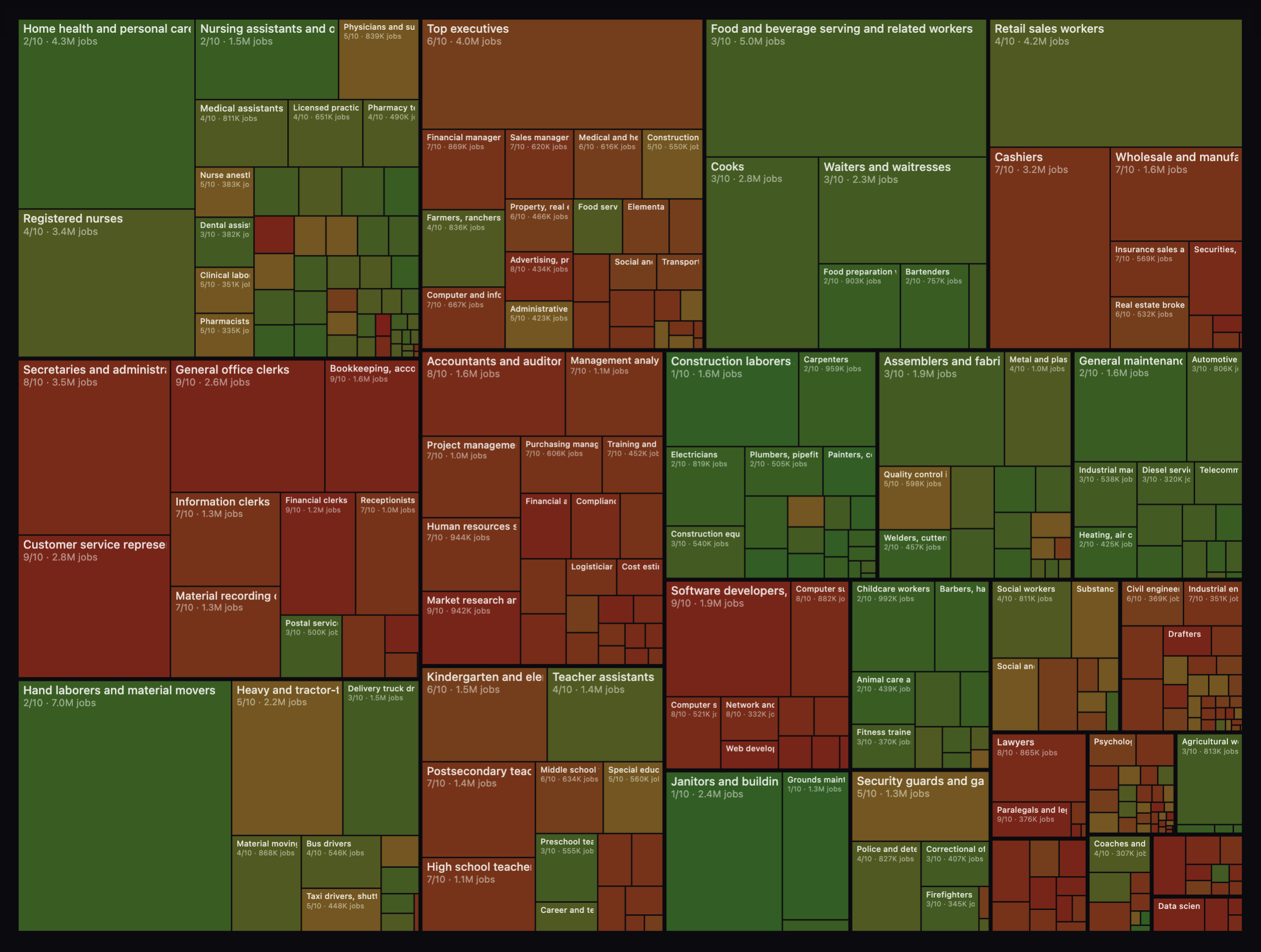
His US Job Market Visualizer maps 342 occupations covering 143 million jobs from Bureau of Labor Statistics data. One of its key views scores each occupation on "Digital AI Exposure": a 0 to 10 rating of how much AI can transform or perform the work.
The visual is intuitive. Green means low exposure: physical, hands-on work that requires a human body in a specific place. Red means high exposure: digital, knowledge work done almost entirely on a computer. The bigger the rectangle, the more people employed in that role.
The red zones everyone's worried about
The red zones are dominated by knowledge work. The jobs most people think of as solid, well-paid office careers. Here's what the data shows:
- Software developers: 9/10 (1.9M jobs)
- Bookkeeping and accounting clerks: 9/10 (1.6M jobs)
- Customer service representatives: 9/10 (2.8M jobs)
- Market research analysts: 9/10 (942K jobs)
- Accountants and auditors: 8/10 (1.6M jobs)
- Secretaries and admin assistants: 8/10 (3.5M jobs)
- Advertising and promotions: 8/10 (434K jobs)
The media reads this as a threat narrative: these jobs are "at risk," these workers will be "displaced." And for people who already hold these roles, the concern is understandable.
But that reading is incomplete. It's the reading of someone who already has a developer, a bookkeeper, and a marketing team.
Now read it as a small business owner
A company with 500 employees looks at "Software developers: 9/10" and worries about headcount. A company with 5 employees looks at the same data point and thinks: I can finally build that customer portal I've needed for three years.
That's the reframe. Every red square on Karpathy's map is a capability that small businesses previously couldn't afford. Not because the tools didn't exist, but because the people who wielded them cost £30,000 to £80,000 a year to hire. Walk through the same list with different eyes:
- Software development (9/10): Custom tools, internal apps, workflow automations. Things that used to require a £50K hire or a £20K agency project. Now achievable for a fraction of that.
- Bookkeeping (9/10): Automated invoice processing, expense categorisation, bank reconciliation. A task that used to eat 10+ hours a week or cost £1–2K a month to outsource.
- Customer service (9/10): AI agents that handle FAQs, route complex queries, and respond at 3am. Something that previously required hiring staff or paying for a call centre.
- Market research (9/10): Competitor analysis, customer sentiment, trend spotting. Work that a large company assigns to a dedicated analyst, and an SME simply never does.
- Advertising and marketing (8/10): Ad copy, campaign strategy, creative variations, performance analysis. The work of a marketing team, now within reach of a founder with AI tools.
- Admin and secretarial (8/10): Scheduling, email management, document drafting, data entry. The invisible work that eats founders' time.
For 95% of small businesses, these capabilities were never on the table. The map doesn't just show what AI might "threaten." It shows what AI has just made accessible to everyone.
The important caveats
Karpathy himself is careful with this data. He notes:
- "A high score does not predict the job will disappear."
- "Software developers score 9/10 because AI is transforming their work — but demand for software could easily grow as each developer becomes more productive."
- "These are rough LLM estimates, not rigorous predictions."
- "Many high-exposure jobs will be reshaped, not replaced."
The scores don't account for demand elasticity, regulatory barriers, or people's preferences for working with other humans. The job displacement concern is real and shouldn't be dismissed. People's livelihoods are at stake, and transitions are painful.
But here's the thing: whether these jobs shrink, grow, or transform, the underlying capabilities are becoming dramatically cheaper and more accessible. That's the part that matters if you're a business owner trying to compete.
What the green zones tell you
The green zones are just as instructive. They're overwhelmingly physical, hands-on, and interpersonal:
- Construction labourers: 1/10
- Home health and personal care: 2/10
- Electricians, plumbers, carpenters: 2/10
- Registered nurses: 4/10
- Cooks: 3/10
The pattern is clear: if the job requires physically being somewhere and doing something with your hands, AI exposure is low. For a business owner, this tells you exactly where to focus AI investment: on the digital, knowledge-based parts of your operation, not the physical delivery.
AI won't lay your bricks, style your customer's hair, or install their kitchen. But it can handle your quotes, your scheduling, your follow-up emails, your bookkeeping, and your marketing. A natural division of labour is emerging: humans do the physical and relational work. AI handles the digital overhead.
The bottom line
Karpathy's map is a menu. Each red square is a capability that's becoming accessible to businesses that could never afford it before.
The question for SME owners isn't "will AI take my job?" It's "which of these capabilities can I finally add to my business?"
That's what we do at Chater AI. We look at your operation, identify the high-exposure capabilities that would make the biggest difference, and implement them. No jargon, no six-figure consulting fees. Just practical AI that saves you money and makes you more competitive.
If you've been running your business without a developer, a marketing team, or a bookkeeper (not because you didn't want one, but because you couldn't justify the cost), the map just changed.