Research
UK Data Confirms It: AI Isn't Killing Jobs — It's Growing Them
New research from the Centre for British Progress analysed three years of UK employment data since ChatGPT launched. The finding? The most AI-exposed occupations are growing faster than the rest of the economy.
The question that's paralysing businesses
"Is AI killing jobs?" It's the question on every business owner's mind. It comes up in every discovery call we do. It's the reason some businesses are still sitting on the sidelines, three years into the most significant technology shift since the internet.
This week, new UK-specific research from the Centre for British Progress answered it with data. Dr Pedro Serôdio and his team broke down the UK labour force by occupation, measured AI exposure across four different dimensions, and looked at what's actually happened to employment since ChatGPT launched in late 2022.
The headline: there is no evidence of a significant negative impact of AI on overall UK employment. None. After three years.
The sectors most exposed to AI are growing fastest
This is the finding that should change how you think about AI for your business. Marc Andreessen, co-founder of the venture capital firm a16z, summarised it bluntly:
"Surprisingly, occupations with higher exposure to AI have grown faster than least-exposed ones, not slower. Not surprising! Productivity growth → economic growth → job growth."
Read that again. The jobs most "threatened" by AI aren't disappearing. They're multiplying. The mechanism is straightforward: when AI makes a worker more productive, the value of that work increases, demand for it grows, and more people get hired — not fewer.
It's the same pattern we've seen with every major technology. Spreadsheets didn't eliminate accountants. ATMs didn't eliminate bank tellers. The internet didn't eliminate retailers. It expanded all of them.
Software: the canary in the coal mine
If AI were going to kill jobs anywhere first, it would be software development. Code generation was one of the first mainstream AI capabilities. GitHub Copilot launched in 2022. Every major AI lab has shipped coding tools. If automation were going to shrink a workforce, this would be ground zero.
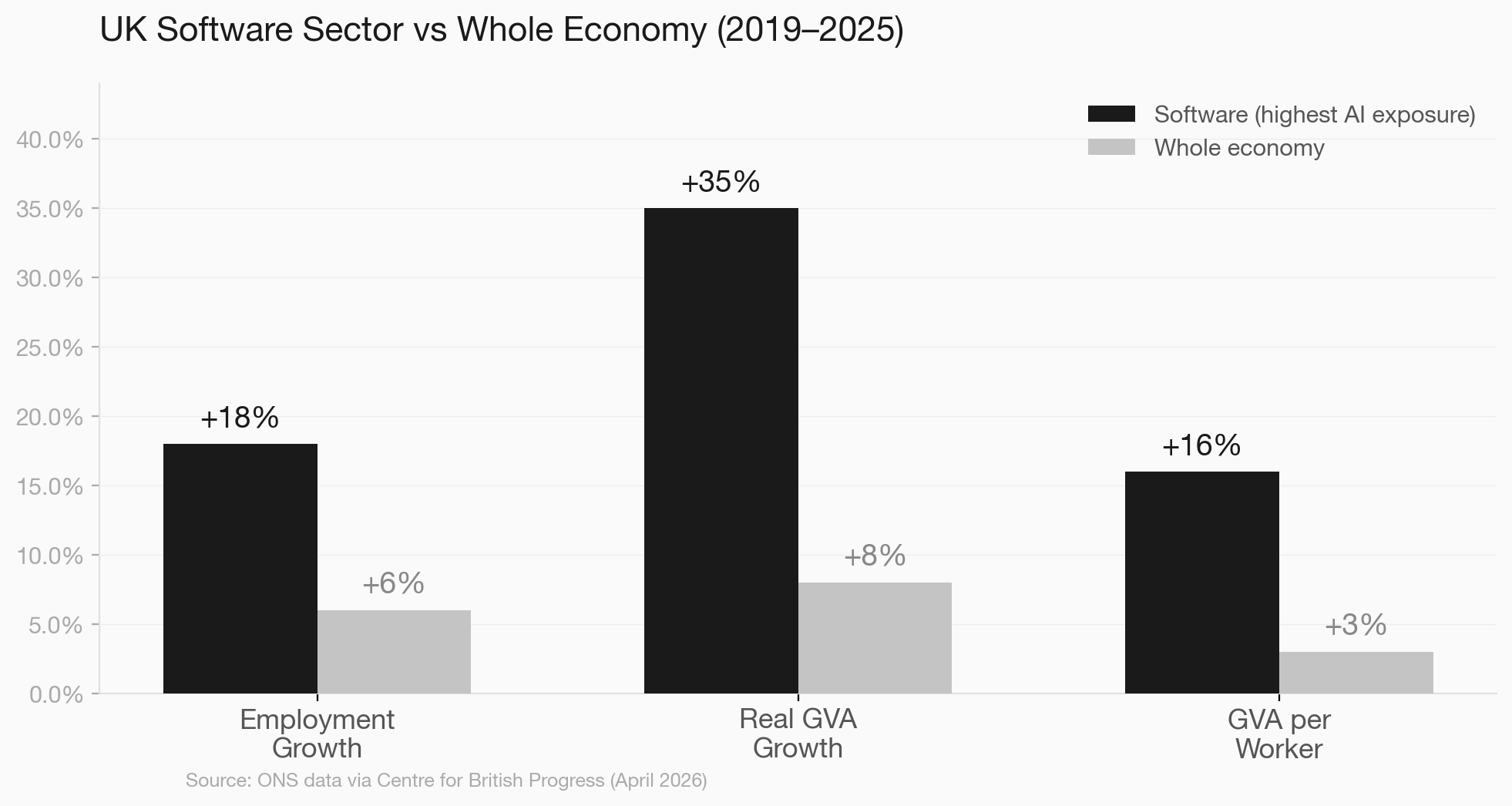
Here's what actually happened in the UK, according to ONS data cited in the report.
- Computer programming employment grew 18% between 2019 and 2025 — three times the economy-wide rate
- Real gross value added (GVA) in software grew 35% in the same period
- GVA per worker rose 16% — meaning each developer is producing significantly more value
More productive. More valuable. More hiring. Not less.
This is what "AI exposure" actually looks like in practice. It doesn't mean the job disappears. It means each person in the role can do more. And when each person can do more, businesses want more of them — because the return on that hire just went up.
The Solow paradox — and why three years is early
The report makes an important historical point. In 1987, the economist Robert Solow famously wrote that "you could see the computer age everywhere except in the productivity statistics."
Previous general-purpose technologies took decades to fully register in economic data. Electricity: roughly forty years. Computing: thirty. We're three years into AI.
This means two things for business owners:
- The absence of mass job loss isn't a fluke. It's consistent with how transformative technologies actually work — they augment before they replace, and the augmentation phase creates growth.
- The productivity gains are still in their infancy. The businesses adopting AI now aren't just getting a head start. They're building the muscle memory and workflows that will compound as the tools improve.
What this means if you run a business
The fear narrative around AI — "it'll take our jobs," "it'll make us obsolete" — is doing real economic damage. Not because AI is harmful, but because the fear is causing businesses to delay adoption.
While you're deliberating, your competitors who've adopted AI are:
- Getting more done with the same team. One person handling the workload that used to require three — not because anyone was fired, but because AI removed the busywork.
- Winning more customers. Faster responses, better marketing, more personalised service. All achievable with AI tools that cost a fraction of an extra hire.
- Making better decisions. Market research, competitor analysis, customer insights — work that small businesses used to skip entirely because it needed a dedicated analyst.
- Reinvesting the savings. Time saved on admin, bookkeeping, and repetitive tasks goes back into growth — new products, better service, expanded reach.
The UK data makes this clear: AI adoption is a growth signal, not a warning sign. The sectors leaning into it are expanding. The businesses within those sectors that are actually using the tools are pulling ahead.
The real risk
The risk was never "AI moves too fast and we can't keep up." The risk is standing still while the economics of your industry shift underneath you.
Every month you wait, the gap widens. Not because AI is replacing your competitors' workers — but because it's making their workers dramatically more productive. They serve more customers with the same headcount. They ship faster. They spend less on overhead. And that productivity advantage compounds.
Three years of UK employment data says the same thing the global data says: AI grows businesses. The question isn't whether to adopt. It's how fast you can start.
The bottom line
The "AI kills jobs" narrative was always more about fear than data. Now the data is in — from the UK specifically, not just Silicon Valley optimists — and it confirms what early adopters already knew: AI makes businesses more productive, more competitive, and ultimately, bigger.
That's what we do at Chater AI. We look at your business, identify where AI will have the highest impact, and implement it. No jargon. No six-month consulting engagements. Just practical AI that makes you more competitive — starting now, while the advantage is still there to take.
Don't let fear cost you growth
Book a free 30-minute call and we'll show you where AI can make your business more productive.
Book a Call